
APFC Panel Manufacturer (APFC & RTPFC)
An APFC (automatic power factor correction) panel switches capacitor banks in and out to hold the plant's power factor close to unity. It cuts the kVA demand on the transformer and avoids power-factor penalties on the electricity bill. APJ Engineers builds APFC and RTPFC panels at its works in Vasai, near Mumbai.
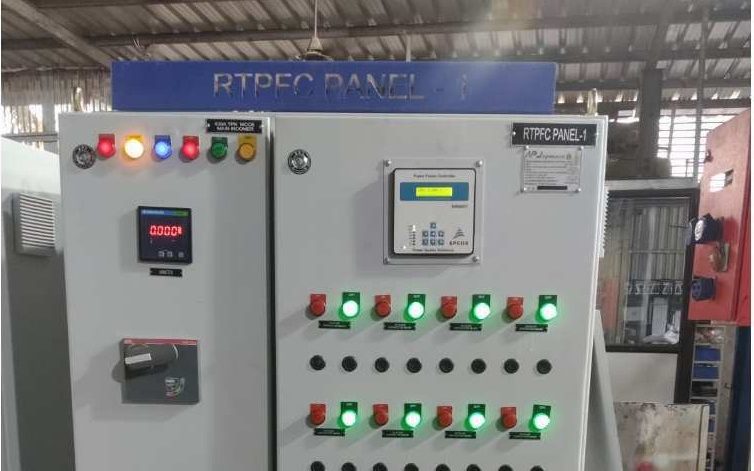
How an APFC panel works
A power factor controller measures the load's reactive power through a current transformer on the incomer. It then switches capacitor steps on or off until the target power factor is reached, and keeps adjusting as the load changes.
APFC or RTPFC?
- APFC (contactor switched): capacitor-duty contactors switch the steps. Suits loads that change slowly, such as general plant and building loads.
- RTPFC (real-time, thyristor switched): thyristor modules switch the steps within a cycle or two. Suits fast-changing loads such as welding, lifts, cranes and presses.
Where the load has many drives, UPS units or other harmonic sources, ask for detuned banks (a reactor in series with each capacitor step) so the capacitors do not resonate with the supply.
Sizing the bank
The kVAr needed depends on the load in kW, the present power factor and the target. The surest way to size it is from a few months of electricity bills or a load study. Send these with the enquiry and we will propose the total kVAr and the step sizes.
What APJ builds
APFC and RTPFC panels at 415 V with capacitor steps, a power factor controller, step protection and ventilation, in powder-coated CRCA enclosures. The assembly standards are IEC 61921 for power-factor correction banks and IEC 61439 for the switchboard. Every panel gets a factory acceptance test before dispatch.
What to send for a quotation
- Single-line diagram (SLD) or BOQ
- Incomer rating and the fault level at the board
- Preferred switchgear make, busbar material (copper or aluminium) and IP rating
- Cable entry (top or bottom) and any size limit at site
- Delivery location and the date you need it
The full list is in our quotation checklist.
Tested before it leaves
Every panel gets an IEC 61439-1 factory acceptance test with recorded readings, photos and a video, witnessed by the client where they wish. Its FAT QR then opens the full record, including later site and service reports.
How our traceability worksType-test certificates
- ASTA 6300 A / 85 kA (forced-cooled)
- ASTA 4000 A / 65 kA
- CPRI 4000 A / 65 kA
- ERDA temperature-rise test, 4000 A
- ERDA IP65 and IP55
- ASTA internal arc, 85 kA for 0.5 s
Request a quotation
Tell us what you need. Your request goes straight to our sales team.
Frequently asked questions
What is the difference between APFC and RTPFC?
An APFC panel switches capacitor steps with contactors, in seconds. An RTPFC panel switches them with thyristors, within a cycle or two, for loads that change quickly.
How many kVAr do I need?
It depends on your load, present power factor and target power factor. Send recent electricity bills or a load study and APJ will size the bank and its steps.
When are detuned reactors needed?
When the load has significant harmonics, for example from VFDs, UPS units or rectifiers. The reactors stop the capacitors resonating with the supply and protect them from harmonic overload.
Where are APJ panels made?
At APJ Engineers' own works at Pelhar, Vasai (Palghar district), near Mumbai: Plot No. 333, Pelhar Village, Opp. Apple Industries, Nalasopara Highway Road, Vasai (East), Palghar, Maharashtra 401208, India.
Is every panel tested before dispatch?
Yes. Every panel gets a factory acceptance test (FAT): IEC 61439-1 routine verification with recorded readings, photos and a test video, using instruments with current calibration certificates. A panel is released for dispatch only after its FAT is passed.
Can I check the test record of my panel?
Yes. Each panel carries a FAT QR code. Scan it, or type the code under it on apje.in, to open that panel's FAT report, drawings and site reports.
Do you supply outside Mumbai?
Yes. APJ supplies across India, with on-site supply, installation, testing and commissioning (SITC) teams.
How do I get a quotation?
Send your single-line diagram or BOQ on WhatsApp (+91-9967717710), call +91-9819917710, or email apj@apje.in.